 2022 Trekking
Adventures
2022 Trekking
Adventures
All inclusive cost, with airfare*:
$4995 from MIAMI
*Includes International & South America flights in Chile, Bolivia and Peru.
September 4 to September 16, 2018
Day 1 – Tuesday, September 4– Departure USA/Santiago
Day 2 – Wednesday, September 5– Santiago/San Pedro de Atacama
Arrival in Santiago and connect on our flight to Calama. Upon arrival in Calama, we continue on a 1 ½ hour bus drive to San Pedro de Atacama (8,000'/2,450 m).
The Atacama Desert is situated between the Andes Mountains and Pacific Ocean and stretches 600 miles (1,000 kilometers) from Peru's southern border into northern Chile. This region is extremely hyper-arid. It is an inhospitable, seemingly lifeless, sun drenched spot that is probably the driest place on Earth. Temperatures in the Atacama vary daily from 95°F down to 32°F.
The Atacama is 10 to 15 million years old and 50 times more arid than California's Death Valley. There are places where rain has never been recorded. This natural environment on Earth poses some of the same challenges for human explorers as would a seemingly lifeless planet. NASA scientists and engineers selected this landscape to test the technology that will be used in places like the Moon or Mars - the Atacama is "the closest place to Mars."
Overnight: La Casa de Don Tomas
Meals: L, D.
Today’s hike: None scheduled.
Today's flight: 2 hour flight from Santiago to Calama. Today's drive: 90 km (55 miles) from Calama to San Pedro de Atacama.
Day 3 – Thursday, September 6– San Pedro de Atacama
Day on your own to relax, rest, recover and enjoy San Pedro de Atacama.
Overnight: La
Casa de Don Tomas
Meals: B, D.
Today’s hike: Optional hikes.
Day 4 – Friday, September 7– San Pedro de Atacama
Today we hike the best trails around San Pedro, including the Kari Canyon and the Valley of Death.
Overnight: La
Casa de Don Tomas
Meals: Breakfast & afternoon grill buffet lunch by the pool.
Today’s hike: 7.5 miles or longer option (12 km).
Today’s drive: Very short distances around San Pedro.
Day 5 – Saturday, September 8– Eduardo Avaroa National Reserve - Laguna Colorada - Desierto de Siloli
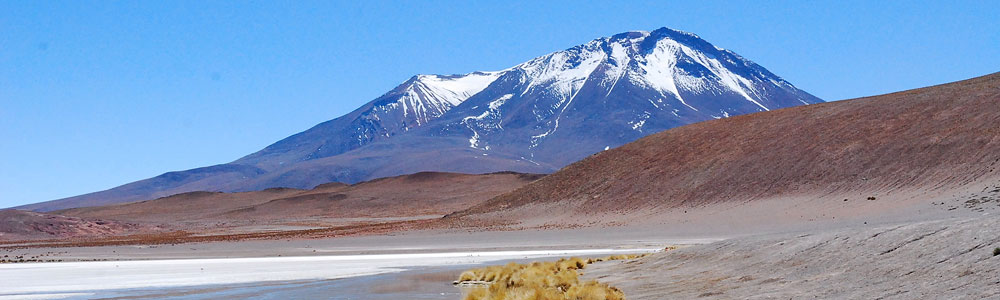
A one hour drive takes us to "Hito Cajon" at the Bolivian border. The Eduardo Avaroa National Reserve is in the southwestern section of Bolivia, bordering Chile and Argentina. This Puna region ranges in altitude from 11,482 feet (3,500 meters) and extends above 16,400 feet (5,000 meters).
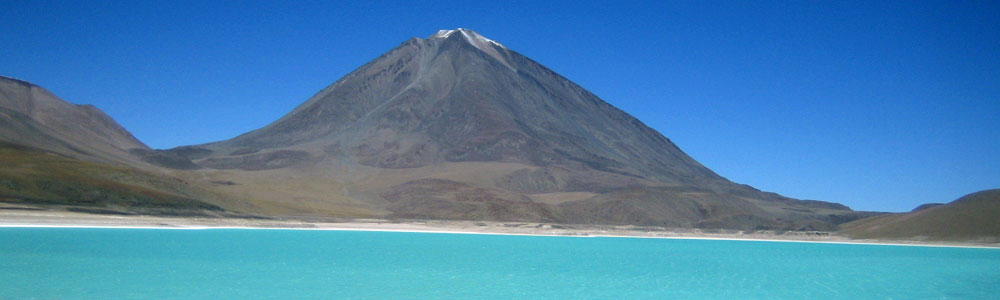
We drive past Laguna Blanca and to Laguna Verde at the base of Licancabur volcano (19,455'/5,930 m)
Continue across the Bolivian altiplano to the hot springs in Laguna Salada and to the active geyser, “Sol de la Mañana”. From there to Laguna Colorada, a lake with a pinkish hue. This naturally occurring color results from algae and minerals in the lake, which is the main source of food for the thousands of pink flamingos. Three of the world’s six flamingo species – Chilean, James’ and Andean breed in this area.
The reserve has mammal species such as vicuñas, pumas, Andean foxes, vizcachas (Andean rabbit similar to marmot) and other. Andean geese, falcons, ducks and large, flightless birds called lesser rheas are some of the 80 species of birds living in Eduardo Avaroa Reserve
Today we do not have a scheduled hike due to the sudden climb to high elevation. We will however have opportunities for acclimatization hikes along the drive.
We continue our drive to our hotel in Ojo de Perdiz.
Overnight: Hotel
del Desierto.
Meals: B, L, D.
Today’s hike: No hike scheduled. Acclimatization hikes
to break the drive..
Today’s drive: About 7 hours with various stops in the altiplano.
Day 6 – Sunday, September 9– San Pedro de Quemez
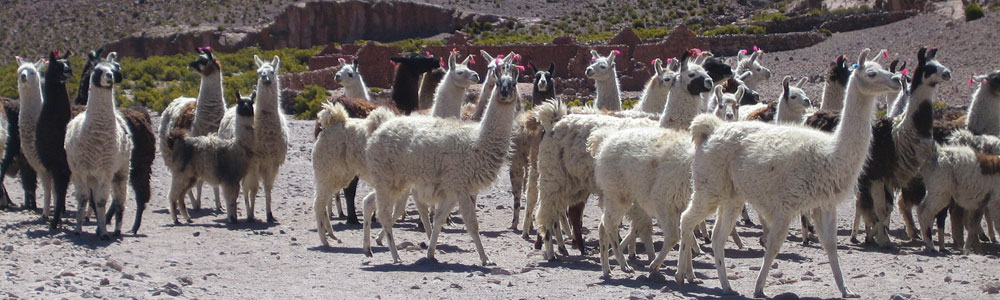
We continue north on the altiplano "high plain" where we will see llamas, wild herds of vicuñas, Andean geese and other wildlife.
Overnight: Hotel
de Piedra.
Meals: B, L, D.
Today’s hike: No hike scheduled. Acclimatization hikes
to break the drive.
Today’s drive: About 7 hours with various stops in the altiplano.
Day 7 – Monday, September 10- Salt flats of Uyuni – Incahuasi Island – La Paz
This morning we enter the impressive Salar de Uyuni, the salar is 4,700-square-miles of salt flats - the largest in the world. Some 40,000 years ago the area was part of Lake Minchin a gigantic prehistoric lake. When the lake dried it left behind two major salt deserts, the largest one - the Salar de Uyuni. The salt is completely white and the depth is about 20 feet. We drive to the start of the hike, which will be on the salt flats and we finish on Incahuasi Island (12,010’/3,660 m) - a rocky outcrop in the middle of the vast white expanse of salt. Here you will see giant cacti covering the island creating one of the most surreal landscapes on earth. It is estimated that these cacti grows only about 1 centimeter per year. Some of the cacti reach up to 36 feet (11 meter) and are 1,200 years old.
We continue to Uyuni and we fly to La Paz.
In La Paz (12,000’/3,660 m), we will have views of the impressive summit of Illimani (21,260'), the highest mountain in the Cordillera Real range on the southeastern side of the city.
Overnight: Hotel Ritz Apart Hotel
Meals: B, L, D.
Today’s hike: About 4 miles (6.5 km).
Today’s drive: 96 miles about 2 ½hours.
Flight: 60 minutes.
Day 8 – Tuesday, September 11– La Paz
La Paz is the administrative capital of Bolivia. We will have a tour of the city’s colonial and historical sections.
A hike is scheduled in La Paz from Achocalla to Valley of the Moon.
Overnight: Hotel Ritz Apart Hotel
Meals: B, L, D.
Today’s hike: Approximately 2 hour hike.
Day 9 – Wednesday, September 12– Tiahuanaco - Island of the Sun - Lake Titicaca
This morning we visit Tiwanacu (also known as Tiahuanaco), one of the oldest cultures in South America. It is believed to be the origin of the Pre-Inca Civilization. It was one of the most advanced cultures at that time. The main structures are the Kalasasaya temple with construction details similar to Machu Picchu's Gate of the Sun, the Akapana pyramid; and the semi-underground temple.
We travel in the highlands and continue along the eastern shore of the lake to the strait of Tiquina, which we cross by ferry and continue along the road overlooking the lake and arrive in Copacabana (12,634').
We take a private boat to the island section of Yumani and hike to our accommodations at the Ecolodge La Estancia.
Overnight: Ecolodge
La Estancia on the Island of the Sun in Lake Titicaca.
Meals: B, L, D.
Today’s hike: None scheduled.
Today’s drive: 45 miles/72 km (La Paz to Tiahuanaco) + 98 miles/158 km (Tiahuanaco to Copacabana).
Day 10 – Thursday, September 13– Island of the Sun – Lake Titicaca
This morning we hike around the island. We follow the trail along the shore, passing by villages, agricultural fields, beaches until we reach Challapampa and from there we continue up to the Chinkana ruins where we turn south and continue on the mountain trail leading us around the island. After the hike we return by boat to Copacabana.
Overnight: Hotel
Rosario del Lago.
Meals: B, L, D.
Today’s hike: About 4 hours.
Today’s drive: None.
Today’s boat ride: 1 hour.
Day 11 – Friday, September 14– Copacabana - Puno
After breakfast we descend to the lake to take our private boat to Copacabana.
A short 15 minute drive to Kasani and across the border to Yunguyo - Perú. Continue overland to Puno (12,560').
Overnight: Hotel Sonesta Posada del Inca – Puno
Meals: B, L, D.
Today’s hike: None scheduled.
Today’s drive: 2.5 hours.
Day 12 – Saturday, September 15– Uros Islands - Sillustani /Lima/Flight Home
After breakfast, we leave from the hotel dock and travel by boat to the "floating islands" of the Uros people who build the famous "totora" reed boats. The Uros and other lakeside dwellers depend extensively on the totora reed. It is used to make fishing boats and homes as well as the famous floating islands of reed.
We end our journey with a flight from Juliaca – Puno to Lima and connect with our flight home.
Meals: B, L.
Today’s hike: None scheduled.
Today’s boat ride: Boat tour to the Uros islands (Peru).
Day 13 – Sunday, September 16– Arrival home
TRIP FEE INCLUDES: • Airport check-in and baggage assistance in Chile, Bolivia and Perú. • All airport departure taxes. • All airport transfers and ground transportation as scheduled on itinerary. • All ground transportation in comfortable private buses. • All meals included: Breakfast, Lunch and Dinner. Vegetarian meals can be accommodated (please request in advance). • All sightseeing tours and park entrance fees to destinations on the itinerary. • All accommodations in Chile, Bolivia & Peru are in fine hotels. Based on double occupancy, rooms are shared by two people. 2 nights are in rustic accommodations and we may share more than 2 per room. • If you are traveling alone and prefer single accommodations you must pay the single supplement. If you are willing to share accommodations and reserve at least 120 days in advance, we will try our best to find a roommate and if that is not possible you will pay only 75% of the single supplement cost. If we find a roommate, but your roommate cancels before departure, the 75% of the single supplement will apply. • The services of professional tour guides. • Our local leaders and guides are knowledgeable about the language, customs, culture and history of their country. They are detail oriented and take great pleasure in sharing their insight and expertise. They help make sure everything runs as safely and smoothly as possible. NOT INCLUDED: • Transfers for independent arrival or departure, travel insurance (highly recommended) for which an application will be included with your confirmation, passport fees, excess baggage fees, Bolivian visa*, optional tips to trip leader, guides and local staff. All items of personal nature such as: personal gear, laundry, telephone calls, beverages, bottled water, etc. *U.S citizens need a visa to enter Bolivia. The cost is $160 and you need to apply through the Bolivian consulate or at Bolivian border (information will be sent). There are no fees or visas required to enter Chile and Perú. Note: Canadians are charged a one-time "Reciprocity fee" of $132, Australians pay US$95. This is paid upon landing at the Santiago International Airport. This is charged in reciprocity for the fee these countries charges Chileans; it is good for the life of the passport and there is no need to pay again for subsequent trips to Chile. Note: All itineraries are subject to change due to circumstances beyond our control including, weather, road or trail conditions and flight schedules.
|



Phone: Send us an e-mail with your phone # if you need us to call you.
Request Info or E-mail 
Andes
Adventures on Facebook